
Recession, Deutsche Bahn, crumbling infrastructure, an automotive industry under massive pressure, supplementary funds in the budget that were cancelled by the Constitutional Court, two wars (almost) on the doorstep, broadband expansion and digitization that have now been abandoned, a Pisa test result in which Germany produced the worst result since the test was recorded, and now a debacle for the German men’s national football team, which more than deserved to lose to Austria in a preparatory match.
Even German flagship companies in today’s hottest technology trend – AI – such as Aleph Alpha are now facing exactly the same challenges as the large American corporations. Aleph Alpha’s language model also hallucinates and praises Hitler and the Nazi Reich.
You can find out more about artificial intelligence in my new book, which has just been published:

KREATIVE INTELLIGENZ
Über ChatGPT hat man viel gelesen in der letzten Zeit: die künstliche Intelligenz, die ganze Bücher schreiben kann und der bereits jetzt unterstellt wird, Legionen von Autoren, Textern und Übersetzern arbeitslos zu machen. Und ChatGPT ist nicht allein, die KI-Familie wächst beständig. So malt DALL-E Bilder, Face Generator simuliert Gesichter und MusicLM komponiert Musik. Was erleben wir da? Das Ende der Zivilisation oder den Beginn von etwas völlig Neuem? Zukunftsforscher Dr. Mario Herger ordnet die neuesten Entwicklungen aus dem Silicon Valley ein und zeigt auf, welche teils bahnbrechenden Veränderungen unmittelbar vor der Tür stehen.
Things are going well for Germany, aren’t they? Anyone who is still optimistic about the country’s future must be a dreamer. “The mood is so bad,” said a friend on the phone recently. The reasons are manifold and many of them are homemade. No single party is solely to blame, as much is the result of years of resting on past successes and a lack of motivation to set new goals. Society as a whole is to blame for this decline.
Old Technologies
While we were proud to have lured Intel to Germany – thanks to 10 billion euros in taxpayers’ money – we are now sobering up. Chip giant Intel, now a mere shadow of its former self, is still worth as much as Germany’s most valuable company SAP at 178 billion US dollars – and that would be worth a separate article on why we don’t produce more valuable companies – but it pales in comparison to the current industry leader Nvidia. Nvidia, whose headquarters in Silicon Valley are just 1.8 kilometers from Intel headquarters, is worth 1.17 trillion dollars on the stock market, more than six and a half times as much. Why? Because after the mobile revolution (smartphones, tablets), Intel has now also overslept the AI revolution and Nvidia dominates the market with a 90 percent share of GPUs and TPUs.
The German taxpayer will not be taken for a fool. Ten billion euros for a company that has the facilities and has mastered the production technology, but does not build the products that are future-proof and in demand on the market, suddenly no longer looks like high-tech and a great effort by German politicians. No matter how much the representatives of Silicon Saxony stand on their feet and take offense, it is what it is. Not only do the technologies of the future not come from us, we are also using taxpayers’ money to bring the companies of the future into the country.
But it gets worse, because people are clinging to their own old technologies. The German car lobby, supported by politicians, is desperately trying to keep the combustion engine alive and make e-fuels palatable. The public is being told all kinds of fairy tales about sustainability and the future, but with a little reading up on the subject, you can very quickly see the opposite. You start to doubt whether our German engineers are really the best in the world. After all, they can’t really be that wrong.
False Pride
Until recently, Germany was proud of its own manufacturing quality and expertise. Especially in the automotive industry, the motto was “when the German industry gets going, Tesla will have to dress warmly” or “German manufacturers just need to pull the blueprints for electric cars out of the drawer and off they go”.
Humbug! Now German companies are going through production hell and the gap is not narrowing, on the contrary, it is widening. Volkswagen has even had to reduce electric car production because demand for its own products is stuttering, while others are rushing from one record quarter to the next.
Disillusionment is also setting in elsewhere. At the IAA in Munich, 40 percent of all manufacturers came from China, while German companies were among the “distant runners-up”. And dozens of car manufacturers from the Middle Kingdom are ready to supply the global markets with their cars, in astonishingly high quality and, above all, digitally closer to the customer than domestic manufacturers can manage.
At the end of November, Tesla delivered the Cybertruck, a new vehicle that is the subject of much controversy. This completely overlooks the innovations that have gone into the vehicle and how they will change the automotive industry again. From the 800-volt battery architecture for faster charging, the 48-volt architecture for higher data rates and with 78 percent less weight in the cable harnesses, or the material processing, the industry is just flapping its ears in amazement. I have written down some thoughts on this in this article.

By the way, what is the discussion about the Cybertruck in Germany? There it is pointed out that such a vehicle would never be registered here. Just like the discussion back then that a square steering wheel like the one on the Model S Plaid was not permitted (as it turns out, it is).
Pride is crumbling, as is the previous arrogance. But elsewhere they persist. After the absolutely miserable cookie regulation – billions of people have to click away cookie pop-ups every day – and a data protection law that massively hampers European companies in particular, now comes the EU AI Act, which imposes immense burdens on domestic companies and for which the legislators now praise themselves with the greatest pride and radiate satisfaction. “Now we’ve shown the world” and “Everyone else is doing the same” is being put forward without realizing that Europe is once again cutting back on innovation.
We regulate, but the innovation is done elsewhere. And this is thanks to a dubious mindset that has turned us from innovation pioneers into obstructionists.
Doubtful Mindset
A few weeks ago, I had a German delegation visiting me, which I took to LinkedIn in Mountain View. Matthias Zeller showed us the building that had been built during the pandemic and where the interior design had been adapted during construction. After the pandemic, how could you ensure that employees would want to come back to the office from their home offices? The result was very comfortable and not at all office-like furnishings that looked more like a living room. There was even a record player in one of the rooms.
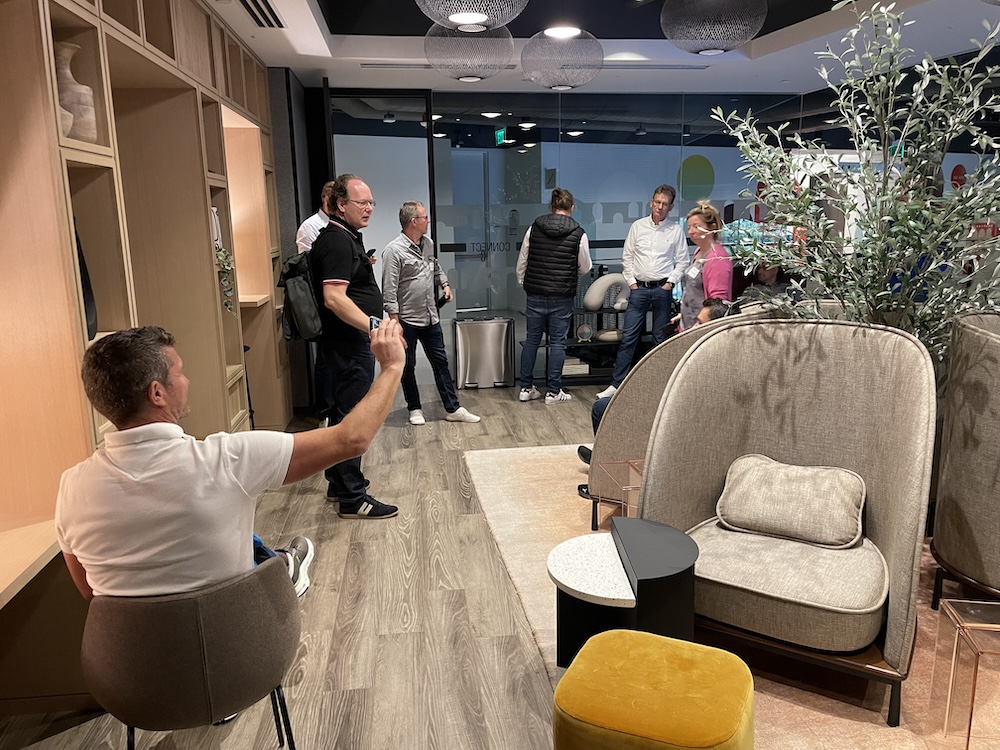
One delegation member came up to me and said, “So it’s not ergonomic”, only to add immediately afterwards, “and I wonder why I think like that and mention ergonomics first, even though I really like it.”
This was not the first time that delegation members have found their own thinking getting in the way. A delegation of CDU members of the Saxon state parliament also noticed this when they were happy about the dogs that the employees had taken with them to an open-plan office and then added that this would not be allowed in Germany. Well, the MPs have it in their hands to change these regulations, they are sitting in exactly this position.
I have already written extensively about these mindset differences in several books, including The Silicon Valley Mindset and Future Angst, in which I also break down the reasons and possible solutions.


Rethinking
We may need one (or more) “moonshot”, as Americans call such high-risk goals that capture the imagination of an entire nation. And SPRIND, the German federal agency for leapfrog innovations, which is supposed to undertake high-risk innovations on the model of DARPA, has launched such a moonshot. Having previously focused primarily on medical innovations, the agency has launched the SPRIND Funke Fully Autonomous Flight innovation competition to develop groundbreaking solutions.
However, this requires a rethink throughout society. Too many people have become too comfortable in their lives, where they go to a lot of conferences to talk intelligently about technology trends, but try out and do far too little themselves. A five-year-old cell phone is good enough for you, but an electric car is nothing for you because you have to go skiing in the Alps once a year and electric is certainly not an option. That’s where you find the fly in the ointment at ChatGPT, because it’s being talked about so badly in the press. Journalists lull their fellow countrymen by focusing on what wasn’t so convincing when testing a new technology and failing to mention what it can do and what its immense potential is. People accept the fact that train travel is a game of chance, cell phone connections are constantly interrupted, the Internet sends data in dribs and drabs, and immediately abandon a technology when someone brings the term “data protection” into play.
It is not the country that is broken, but the way society thinks. Europe in general and Germany in particular are at a crossroads. If we don’t take ourselves by the nose and continue to be so hostile to science and technology, then we’re screwing up the future for our children.
140 years ago, the wave of German founders began, giving rise to German flagship companies such as Bosch, Siemens, Mercedes, VW, Allianz and Steiff. What companies have we created so far that our children will mention? If we not only rethink now, but also start to behave differently, then our generation will go down in the history books as the generation of failures. And in Austria, people will still be celebrating the victory against the German national team. Is that really what we want?
Addendum
ChatGPT 4.0 generated the cover image for me with the text instruction “Create an image of Germany with a bad mood“. You can find more tips on image generation with generative AI and on artificial intelligence in general in my new book “Kreative Intelligenz”, which has just been published.
KREATIVE INTELLIGENZ
Über ChatGPT hat man viel gelesen in der letzten Zeit: die künstliche Intelligenz, die ganze Bücher schreiben kann und der bereits jetzt unterstellt wird, Legionen von Autoren, Textern und Übersetzern arbeitslos zu machen. Und ChatGPT ist nicht allein, die KI-Familie wächst beständig. So malt DALL-E Bilder, Face Generator simuliert Gesichter und MusicLM komponiert Musik. Was erleben wir da? Das Ende der Zivilisation oder den Beginn von etwas völlig Neuem? Zukunftsforscher Dr. Mario Herger ordnet die neuesten Entwicklungen aus dem Silicon Valley ein und zeigt auf, welche teils bahnbrechenden Veränderungen unmittelbar vor der Tür stehen.