
Since the launch of ChatGPT in November 2022, artificial intelligence has not only begun to transform the work and personal lives of billions of people in a very short time—and has made immense progress in the process—but has also faced a backlash. Initial experiments with ChatGPT and other language models that soon followed—such as Claude from Anthropic, Gemini from Google, or specialized models like those from Seedance—where users could (mostly) still chuckle at the many hallucinations and convince themselves that AI would probably never work properly—soon gave way to disillusionment. Often within just a few months, the latest models mastered increasingly complex tasks and tests, penetrating more and more areas of life.
AI Gold Rush
The new AI gold rush has led to an investment boom on a scale we have never seen before. By 2025, major American tech companies had invested at least $500 billion in the expansion of AI data centers and AI development. And by 2026, these figures are on track to exceed $700 billion. However, as I’ve already explained here, it would be wrong to compare this boom to the dot-com bubble around 2000. Back then, it was venture capitalists and startups investing in the internet; today, it’s multibillion-dollar companies that can raise such sums relatively easily and have enough capital to finance the expansion and development.
Power Requirements
Data centers—which require hundreds of thousands or even millions of GPUs for training, data storage, and the operation of artificial intelligence—have proven to be a point of contention. The size of a data center is not measured in square meters, FLOPS (floating-point operations per second), or the number of GPUs, but rather by its power consumption in gigawatts (GW). By way of comparison, a nuclear power plant produces an average electrical output of 1 to 1.4 gigawatts.
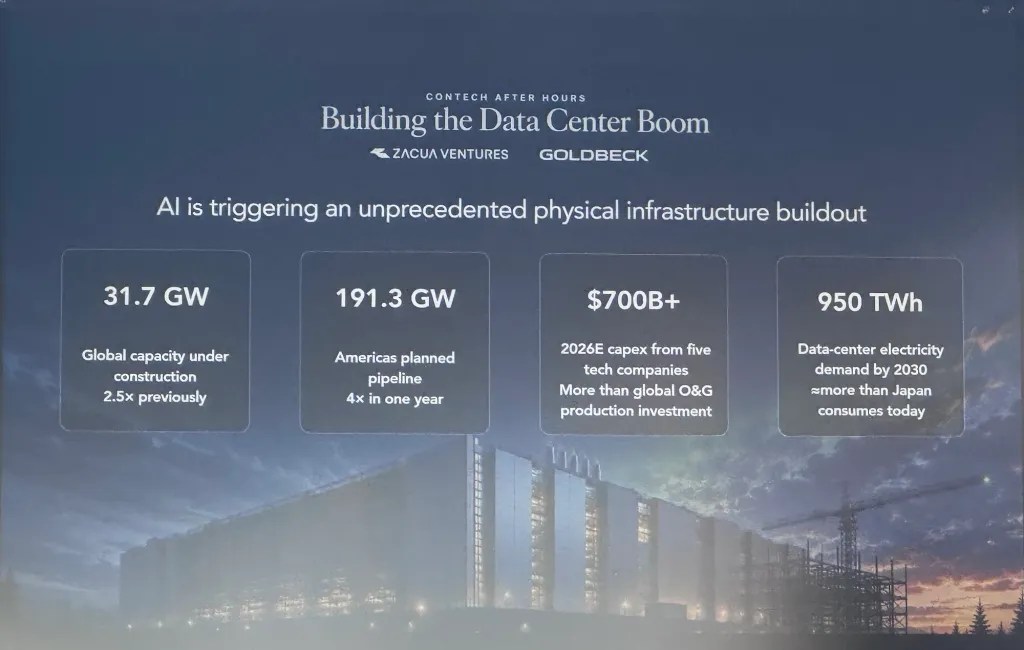
Currently, data centers with a total capacity of 31.7 GW are under construction worldwide, which is two and a half times the capacity of those already under construction. However, the United States is in the process of building 191.3 GW—more than four times the capacity already under construction. A projection for 2030 estimates an electricity demand of 950 TWh, which is more electricity than all of Japan consumes.
This highlights both the intense search for data center sites and the need to meet the demand for energy (and water for cooling). Every type of energy source—whether fossil or non-fossil, including decommissioned nuclear power plants—is being considered, expanded, or reactivated.
Widerstand
The intensity of the opposition to data centers has come as a surprise to tech companies. And this opposition is rooted in several experiences. For instance, companies entice local communities with the promise of billions in investments that would bring jobs and tax revenue to the region. Yet the experiences of communities with data centers have proven to be mixed at best. Although data centers themselves are expensive, they can be operated by just a few dozen employees. The well-paid employees are specialists who are usually not available locally; the remaining employees work in security and maintenance—that is, in less skilled and therefore lower-paying jobs.
At the same time, electricity and water consumption are enormous and place an excessive burden on local communities. The result is higher energy and water prices, which residents are forced to pay. The noise from the cooling systems for the air-conditioned data centers also disturbs the surrounding area.
And this is where resistance is forming. Residents are flocking to town hall meetings to express their (mostly) opposition. In addition to the reasons mentioned so far, this reflects, above all, frustration with and skepticism toward technology companies. First, AI comes along and takes away people’s jobs; at the same time, job application platforms use AI to screen applicants, algorithms determine whether someone qualifies for a mortgage, and AI-generated posts, images, and videos flood social media, making it increasingly unclear what is real and what is AI-generated; AI is trained on the works of creative artists without their consent and without them receiving appropriate compensation; then there are AI-driven scam calls and fraud schemes; AI is used by the police, immigration authorities, and in weapons systems; and tech companies are given free rein through generous donations to the political elite. At the same time, many feel exploited and powerless in the face of AI.
This makes the idea of a data center right on the city’s doorstep the only tangible avenue through which citizens can have a direct say and voice their discontent. The situation is so volatile that some U.S. states have even gone so far as to declare a moratorium on the construction of data centers. For the time being, they are not issuing any building or operating permits.
Lösungen?
Yet this technology is one of the most important in human history, and its direction and beneficiaries should not be determined solely by the leaders of tech companies themselves, but by society and policymakers in the best interests of citizens.
In a recent panel discussion in Silicon Valley, I witnessed just how much the representatives of tech companies live in a bubble where they fail to understand or grasp people’s legitimate fears and concerns. The response that “tech companies would do a great deal anyway to convince people” simply isn’t enough. Concrete steps are needed.
In addition, these companies can take a cue from the approach of other tech firms that bring technology right into people’s neighborhoods, making it impossible to overlook. For example, Google’s sister company Waymo took a gradual approach to rolling out its robotaxis in what are now 15 U.S. metropolitan areas. Even when it received its first commercial license in San Francisco, more than 80 organizations signed a statement of support. From the Blind Veterans Association to Mothers Against Drunk Driving, these interest groups submitted amicus curiae briefs. Even before that, Waymo had held local exhibitions, events, and open houses that gave the public the opportunity to learn more about robotaxis, ask questions, talk to employees, and experience a ride in a robotaxi firsthand.
This approach seems better than promising tax revenue and jobs that don’t materialize later on, leaving people to deal with higher electricity and water bills.
Elon Musk, Jeff Bezos, and even Google are also looking for alternatives: data centers in space, where there are no disruptive neighbors. Even though the technological challenges for data centers in orbit are still far from being resolved, Elon Musk is already talking about a million data centers that he plans to deploy in space. By way of comparison: today, there are fewer than 15,000 satellites in orbit, two-thirds of which belong to Elon Musk’s Starlink. However, one million data centers positioned 24 kilometers apart would bring new challenges and problems. This is precisely why initial resistance is emerging here as well, since people do not necessarily see how the advantages outweigh the disadvantages.
The era of introducing technologies without taking people’s needs into account ended, at the very latest, with the launch of ChatGPT in 2022. Solutions must be found for a more gradual rollout.
More
The Verge has published an interesting article about Loudoun County in the U.S. state of Virginia, where 250 data centers have been put into operation since 2007. The article describes both the many positive and negative impacts.